


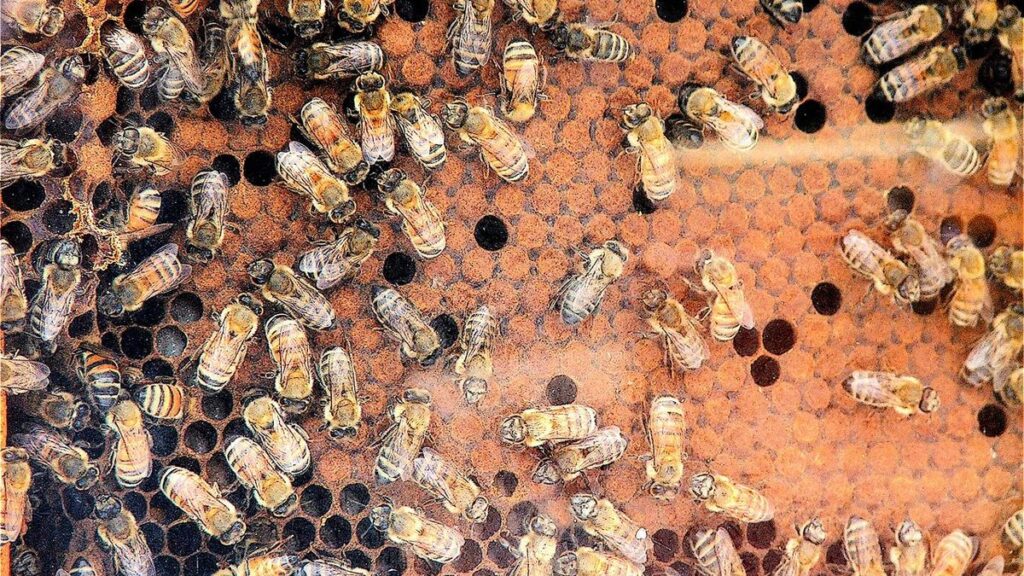
Sooner or later almost every new beekeeper opens a hive, looks at frame after frame and thinks: where is the queen? Not finding her is normal. She is one bee among thousands, and even experienced beekeepers miss her regularly. What matters is not spotting the queen herself, but knowing whether the colony has a laying queen, a new queen on the way, or no queen at all.
This guide explains how to read the evidence in the hive, which signs are reliable and which ones mislead beginners, how to confirm the situation with a simple test frame, and what your options are once you know. It finishes with a short checklist you can take to your next inspection.
Why a missing queen matters
The queen is the only bee in a normal colony that lays fertilized eggs. Every new worker, and every future queen, starts as one of her eggs. A colony without a laying queen cannot replace the workers that die every day, and in the active season a worker lives only a few weeks. If nothing changes, the population shrinks steadily, the colony becomes weaker against robbing and pests, and eventually it fails.
The good news is that bees have their own backup plan. When they lose their queen and still have young larvae, they can raise a replacement. Your job is to figure out which stage the colony is in, so you do not interfere with a solution the bees are already working on, and so you do not wait too long when they cannot solve it alone.
Look for eggs first, not the queen
The fastest and most reliable sign of a laying queen is fresh eggs. An egg is a tiny white grain, about the size of a short piece of thread, standing upright or slightly tilted at the bottom of a cell. Eggs hatch after about three days, so if you see eggs, a queen was laying very recently.
To see them clearly:
- Choose a bright day and stand with the sun behind you.
- Hold the frame so the light shines down into the cells.
- Check frames in the center of the brood nest, where the queen usually lays.
- Tilt the frame slowly; eggs often become visible only at a certain angle.
- Use reading glasses or a small magnifier if your close-up vision is not sharp.
If you find eggs in a neat pattern, one per cell, you have a laying queen even if you never see her. Close the hive and move on.
Reading the brood stages
When you cannot find eggs, the next clues are young larvae and capped brood:
- **Young larvae**, small white curled grubs sitting in a pool of food, mean a queen was laying within roughly the last week.
- **Capped worker brood only**, with no eggs or young larvae, suggests the queen stopped laying more than a week ago.
- **No brood at all** in the active season is a strong warning sign, unless there is a good seasonal reason, such as a natural pause in late autumn or during a long nectar dearth.
Signs that point to a queenless colony
No single sign proves the colony is queenless, but several together build a clear picture. Watch for:
- **No eggs and no young larvae** on several brood frames during the active season.
- **Queen cells** hanging from the face of the comb, which may be emergency cells built after the queen was lost.
- **A loud, steady roar** when you open the hive. Queenless colonies often sound different, with a moaning or anxious hum.
- **Restless, agitated bees** that run on the frames and are more defensive than usual.
- **Empty cells being filled with nectar and pollen** in the middle of the brood nest, because there is nothing to lay in them.
- **A shrinking population** compared with your previous inspection.
Signs that look scary but are often normal
- **Not seeing the queen.** This alone means very little.
- **A gap in brood after a swarm or a split.** A new queen needs time to emerge, mature, mate and begin laying. During that time there will be no eggs, and that can be completely normal.
- **Supersedure cells** high on the face of the comb while eggs are still present. The colony may simply be replacing an older queen.
The test frame: the simplest way to confirm
If you are not sure, borrow a frame from another healthy colony that contains eggs and very young larvae. Shake or brush off the bees so you do not move the other colony’s queen by accident, and place the frame in the middle of the suspect hive. Check again after a few days.
The result is usually easy to read:
- **The bees build queen cells on the test frame.** The colony has no queen and knows it. You can let them raise a queen from those cells or introduce a mated queen.
- **The bees raise the larvae as normal workers and build no queen cells.** The colony believes it has a queen, perhaps a virgin queen that has not started laying yet. Give her time.
- **The eggs disappear or the colony stays strange and restless.** Look more closely for laying workers, described below.
The test frame has another benefit: even if the result is unclear, it adds young bees to a colony that has stopped raising its own, which slows the population decline.
Laying workers: the problem to catch early
If a colony stays queenless for weeks with no young larvae to raise a new queen, some workers can begin to lay eggs. They cannot mate, so their eggs develop only into drones. The signs are distinctive:
- Several eggs in one cell, often stuck to the side walls instead of centered at the bottom.
- Drone brood with raised, bullet-shaped cappings scattered in worker-sized cells.
- A spotty, irregular pattern with no worker brood.
Laying-worker colonies are difficult to fix, because the bees often reject a new queen. Common approaches include combining the colony with a strong queenright hive, or adding a frame of young brood each week for a few weeks until the bees accept a queen or build queen cells. Many beekeepers find that combining is the most practical choice, especially late in the season.
Your options once you know
When you have confirmed the colony is queenless and still has workers in good numbers, you have three main options.
Let the bees raise their own queen
If there are eggs or young larvae available, either from the colony or from a test frame, the bees can produce a queen. This costs nothing and often works well in the warm part of the season, when there are plenty of drones for mating. The downside is time: from egg to a mated, laying queen takes several weeks, during which no new workers are produced.
Introduce a mated queen
Buying a mated queen is the fastest way to restore laying. She usually arrives in a small cage with a candy plug. Place the cage between two brood frames so the bees can get used to her scent while they slowly eat through the candy. Wait several days before checking, and avoid disturbing the hive during that period, because early inspections can cause the bees to reject her.
Combine with another colony
If it is late in the season, if the colony is already small, or if you suspect laying workers, combining it with a queenright colony can be the wiser choice. The newspaper method is the classic technique: place a sheet of newspaper between the two boxes, make a few small slits, and let the bees chew through it over a couple of days while their scents mix.
Quick checklist for your next inspection
- Look for eggs first, in good light, on central brood frames.
- Note larvae and capped brood to estimate when the queen last laid.
- Count queen cells and note where they are on the comb.
- Listen to the colony’s sound and watch how the bees behave.
- Remember recent events, such as a swarm, a split or a queen introduction.
- If still unsure, add a test frame of eggs and young larvae and check again in a few days.
- Act quickly if you see multiple eggs per cell or scattered drone brood.
Summary
A queenless colony is a common beginner worry, and most of the time it is solvable. Focus on eggs and young larvae rather than the queen herself, read the brood pattern to understand the timeline, and use a test frame whenever you are unsure. Once you know what is going on, choose between letting the bees raise a queen, introducing a mated queen, or combining the colony. Regular, calm inspections are your best tool: the earlier you notice the problem, the more options you have.
Photo: MALTESE HONEY (3045715262), by KNOW MALTA by Peter Grima, license CC BY-SA 2.0, via Wikimedia Commons. Cropped.