


Harvest day sounds simple until you lift the first full super and find thousands of bees still walking over the frames. Taking honey without a plan for those bees leads to stings, crushed workers, robbing and a sticky mess in the kitchen.
This guide explains the main pieces of equipment beekeepers use to clear bees from honey supers: escape boards, fume boards, bee blowers and the humble bee brush. You will learn how each one works, how to set it up, which hive sizes and schedules it suits, and the mistakes that cause most harvest-day problems.
Why clearing supers needs its own gear
During a strong flow, the bees treat the honey supers as part of their home. They guard the comb, fan it to finish ripening the nectar and walk across it constantly. If you shake or brush every frame one by one, you leave the hive open for a long time, you release a lot of alarm pheromone and you give robber bees and wasps a clear invitation.
Clearing equipment solves that by moving most of the bees down into the brood boxes before you open the supers, or by moving them quickly in a single step. A good clearing method should do three things:
- Remove nearly all bees from the supers without harming them.
- Keep the honey supers closed to robbers for as short a time as possible.
- Leave the queen safely below, in the brood nest.
Before you clear anything, confirm the honey is ready. Most frames should be capped, and uncapped cells should not drip nectar when you give the frame a firm horizontal shake. Clearing supers that are not ripe only means extracting honey that may ferment later.
Bee escape boards: slow, gentle and cheap
An escape board is an inner-cover-sized board fitted with a one-way device. Bees can walk down through it into the brood boxes but have trouble finding the way back up. You place it between the brood chamber and the supers, wait, and come back to supers that are mostly empty of bees.
Common escape designs
- Porter escapes: a small plastic or metal device with springy tines that let bees push through in one direction. They fit into the hole of a standard inner cover. They work, but a single drone or a bit of propolis can jam them.
- Triangle or maze escapes: a flat board with a triangular or zigzag path printed or routed underneath. Bees exit through narrow gaps at the corners and rarely find their way back. They have no moving parts and are less prone to clogging.
- Multi-exit and rhombus boards: variations with several exits, popular because one blocked exit does not stop the whole board.
How to use an escape board
- Check that there is no brood in the supers. Bees will not abandon brood, and the board will not clear that box.
- Lift the supers off, set the escape board on the top brood box with the exit side facing down, and put the supers back on top.
- Make sure the supers are bee-tight. Any gap, crack or loose lid becomes a robbing entrance, because the supers soon have honey but few guards.
- Return after roughly one to two days. Leaving the board much longer gives bees time to find the way back and wax moths or small hive beetles a chance to move into weakly guarded comb.
- Remove the supers in the morning or early evening, when fewer foragers are flying.
Escape boards suit hobby beekeepers with a few hives, because they cost little, need no chemicals and are very calm on the bees. The drawback is that you visit each hive twice.
Fume boards: fast clearing with a repellent
A fume board is a frame covered on top with a dark, usually metal, sheet and lined underneath with absorbent cloth. You apply a commercial bee repellent to the cloth, place the board on top of the honey super and let the sun warm it. The scent drives the bees downward, and a super can often be cleared within minutes.
Using a fume board well
- Read the product label. Use only repellents sold for clearing bees from supers and follow the dose and safety directions on the label. Labels and approved products differ by country.
- Work in warm, sunny weather. The dark top heats up and releases the scent. On cool or cloudy days, fume boards work slowly or barely at all.
- Use as little as the label allows. Too much repellent can drive bees out of the hive entrance instead of down into the brood boxes and may leave an odor on the comb.
- Smoke lightly first. A few puffs at the top bars start the bees moving before the board goes on.
- Do not leave it on too long. Once the super is clear, remove the box and move to the next one.
Fume boards fit beekeepers who harvest many hives in one visit. Some repellents have a strong, unpleasant smell, so store the board in a sealed bag away from your honey house and equipment.
Bee blowers: speed for larger apiaries
A bee blower is a high-volume, low-pressure air blower, often a modified leaf blower with a long flat nozzle. You lift the super off, stand it on its end on a stand or on the ground in front of the hive, and blow the bees out from between the frames toward the entrance.
Blowers are fast and need no chemicals, which makes them common in sideline and commercial operations. They also have clear trade-offs:
- They are noisy and the bees become defensive, so wear full protective gear.
- Bees are scattered into the air, and some end up in the grass or on you.
- Equipment costs more than a board, and you need a power source or fuel.
- Blowing too close or too hard can damage soft uncapped comb.
If you choose a blower, set up near the hive so the bees land at the entrance, and keep a cloth or cover ready for the cleared supers.
The bee brush and the shake: for a few frames
For one or two hives, or when you only take a few frames, many beekeepers simply shake and brush. You lift a frame, give a sharp downward shake over the open brood box, and gently sweep the remaining bees off with a soft bee brush. The cleared frame goes straight into an empty, covered box.
Tips that make this method work:
- Keep the brush damp and clean; sticky bristles roll bees instead of sweeping them.
- Brush with light single strokes, not scrubbing back and forth.
- Cover the box of cleared frames with a damp towel or lid at all times.
- Work quickly, because every minute the hive is open adds to robbing pressure.
Choosing the right method
There is no single best tool. Match the method to your situation:
- One to five hives, no hurry: escape board, with a bee brush to finish any stragglers.
- Several hives in one trip, warm weather: fume board.
- Large apiary or out-yard work: bee blower, often combined with fume boards.
- A few frames only: shake and brush.
Many experienced beekeepers keep two methods on hand, for example an escape board as the default and a brush for the last bees, because weather and colony temperament change from one harvest to the next.
Common mistakes on harvest day
- Brood in the supers. If the queen laid above the excluder, no clearing method will empty that box. Check before you start.
- Leaks and gaps. A cracked super or a lid that does not seal turns a cleared box into a robbing target.
- Leaving escape boards on for a week. Bees find their way back, and unguarded comb attracts pests.
- Clearing in cold weather. Bees cluster and stop moving through escapes, and fume boards barely work.
- Stacking cleared supers in the open. Within minutes, foragers from your own and nearby hives will find them. Carry them to a closed room or vehicle right away.
- Forgetting the queen. Before you carry boxes away, glance at the frames and the bottom of each super. Losing a queen in the honey house is a costly mistake.
Summary
Clearing honey supers is easier with the right equipment. Escape boards are cheap and gentle but need two visits; fume boards clear supers in minutes on warm days when used according to the product label; bee blowers suit larger operations that can handle the noise and cost; and the shake-and-brush method still works well for a few frames. Whatever you choose, check for brood first, keep the supers bee-tight, work in good weather and move cleared boxes indoors quickly to avoid robbing.
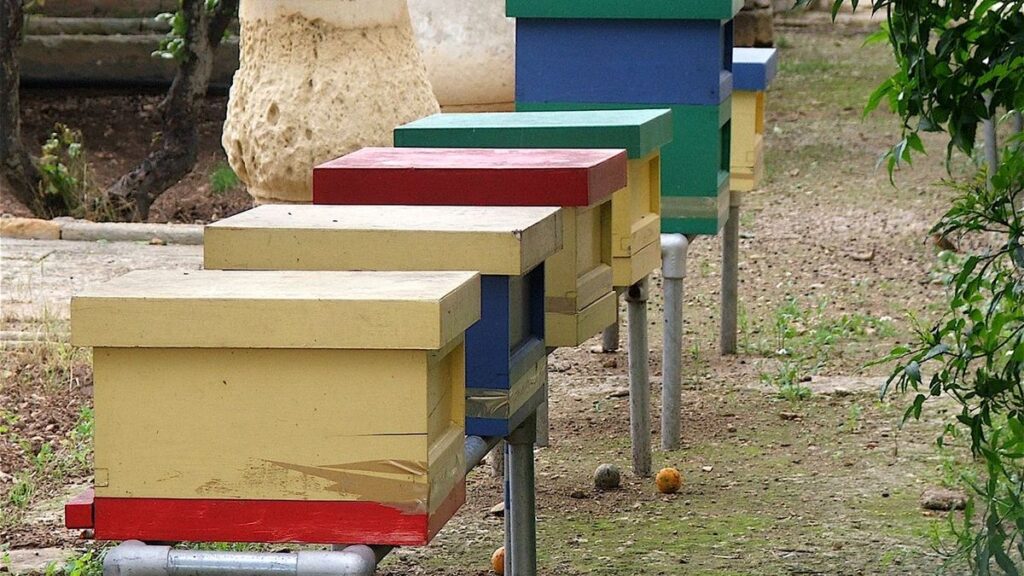
Photo: Maltese honey (3044867663), by KNOW MALTA by Peter Grima from MALTA, license CC BY-SA 2.0, via Wikimedia Commons. Cropped.